Let’s talk numbers first
The French Riviera has the glamour. Portofino has the charm. Monaco has the postcode. But none of them offer what Marbella’s Golden Mile does at its price point — and that gap is wider than most buyers realise
The Golden Mile averages €6,789–€7,036 per square metre in 2025/26, up roughly 6.9% year-on-year. At first glance that sounds expensive. Put it next to the competition and it looks like a bargain.
Saint-Tropez averages €24,565/m², with prime spots reaching €62,500. Porto Cervo in Sardinia sits at around €19,375/m². Even Mallorca’s most expensive area, Andratx, averages €7,411–€8,923/m².
The Golden Mile is the only place in this bracket where you get year-round infrastructure, 300+ days of sunshine, a 30-minute airport, and a live luxury market — without paying Riviera prices to get in.

Why is it cheaper than St Tropez but holds its value just as well?
Good question. A few reasons.
Saint-Tropez and Monaco operate in a different tier partly because of France’s fiscal regime, the sheer density of ultra-high-net-worth concentration, and — in Monaco’s case — zero income tax. They’re not just beach markets, they’re wealth-management addresses. Marbella doesn’t compete on those terms, which is actually a feature. The buyer profile here is HNW but not necessarily ultra-billionaire, which means a more liquid, more functional market.
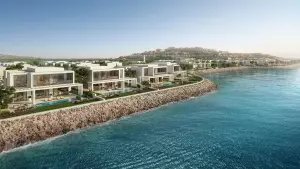
Prime beachfront residences near Puente Romano have surpassed €30,000/m², placing the Golden Mile in an elite global bracket comparable with Monaco, St Tropez, and Miami Beach — but only for the very best frontline positions. The rest of the market remains accessible by comparison, which is exactly why transaction volumes are strong.
A brief history of how it got here
The Golden Mile didn’t become prestigious overnight. It was built up in layers:
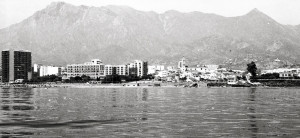
1950s–60s: Prince Alfonso von Hohenlohe opens the Marbella Club. The jet set arrives.
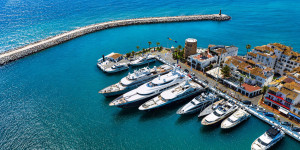
1970s–80s: European royalty, Saudi money, and the rise of Puerto Banús put Marbella on the global luxury map.
1990s–2000s: Russian and Eastern European buyers diversify demand. The international school network expands.
2010s: Digital nomads, lifestyle relocators, and the Golden Visa (2013–2025) drive a new wave of Northern European and Middle Eastern buyers.
2020s: Post-pandemic acceleration. A strong presence of cash buyers reduces sensitivity to interest rate fluctuations, and continued demand from Northern Europe, the UK, and the Middle East is driven by Marbella’s year-round lifestyle appeal rather than just seasonal tourism. Americans arrive in volume.
Each wave added a new layer of demand without replacing the last. That’s rare, and it’s a big part of why the market is so resilient.

What you actually get for the money
This is where Marbella pulls ahead of most comparable markets on a value-for-lifestyle basis.
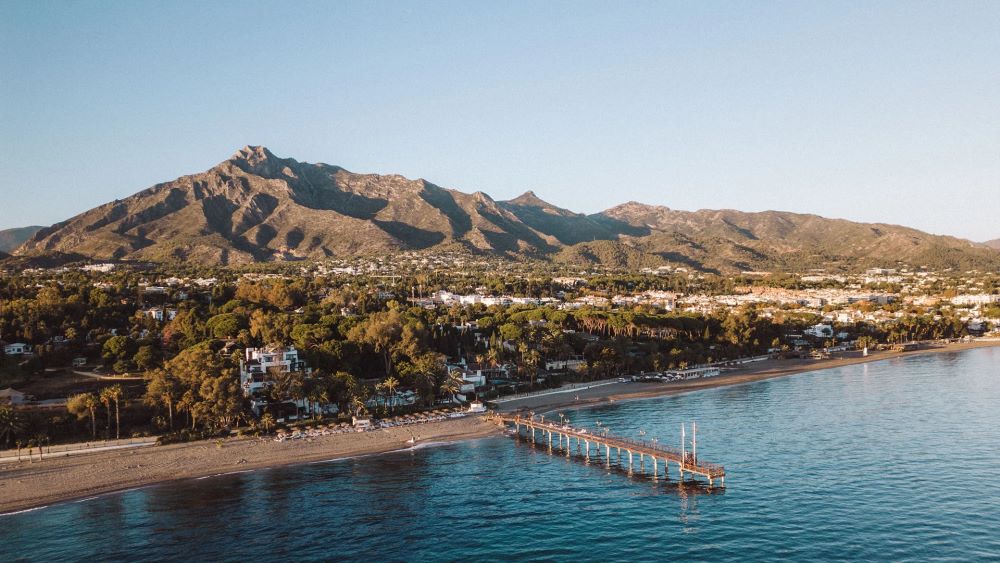
Weather: 300+ sunny days per year, protected by La Concha mountain which keeps winters milder than the rest of Andalusia
Infrastructure: Málaga Airport — one of Europe’s most connected — is 30 minutes away with direct flights to over 100 cities
Healthcare: World-class private hospitals and specialist clinics, heavily used by the expat community
Schools: A concentration of international schools (British, American, Scandinavian, German) within 20 minutes of the Golden Mile
Food: Multiple Michelin-starred restaurants including Skina, Dani García, Messina; plus Nobu, Cipriani, and Coya at Puente Romano itself
Golf: 15+ courses within 20 minutes, including Valderrama
Saint-Tropez, for all its appeal, shuts down in winter. Portofino is gloriously beautiful and functionally inaccessible. Porto Cervo is seasonal by design. Marbella operates at a high level twelve months a year, which matters enormously to buyers who want to actually live there — not just visit.
Supply isn’t going up
Development land along the Golden Mile is exceptionally limited — buildable plots in established beachfront and second-line positions are scarce. This is not a temporary supply gap; it is a structural constraint created by geography, mature urbanisation, and regulatory oversight. There are no new frontline villas coming. When one comes to market, it sells.
Properties priced correctly at the start of the year often attract early interest before spring competition increases. Buyers who wait for prices to soften have been waiting a long time.

The bottom line
The Golden Mile is not the most expensive luxury coastal market in Southern Europe. It’s the best value one. You’re paying significantly less per square metre than you would in Sardinia, the French Riviera, or even parts of Mallorca — for better year-round infrastructure, stronger liquidity, and a market that has absorbed multiple economic cycles without a serious correction.
That combination — scarcity, lifestyle, infrastructure, and relative affordability against comparable markets — is what keeps prices moving in one direction.