A Prince, a Broken-Down Car, and a Farmhouse
The story usually starts in 1946. A German prince, Maximilian de Hohenlohe-Langenburg, was driving along the coast with his son Alfonso when their car broke down near Marbella. They stopped. They looked around. Alfonso liked what he saw.
A year later he bought Finca Santa Margarita, an old farm between the sea and the mountains. He built a home for his family and sold plots to friends. Some of those friends happened to be Rothschilds and Thyssens.
By 1954, the finca had become something else: the Marbella Club. Twenty bedrooms, a dining room, a bar, and a quiet insistence on privacy. It was the first true luxury hotel on this coast, and it changed everything. Within a few years, Ava Gardner, Grace Kelly, Cary Grant, and the Duke of Windsor were regulars. The stretch of coastline in front of it later earned its own name: the Golden Mile.
The Marina That Wasn’t Meant to Exist
Alfonso wanted Marbella to stay small and discreet. A developer named José Banús had other ideas.
In the 1960s, Banús began building a marina and residential district a few kilometres west of town, on land that had once been used for breeding bulls. Alfonso was reportedly furious when he heard the scale of the plan. He is said to have threatened to sell his hotel and leave Marbella altogether if it went ahead as designed.
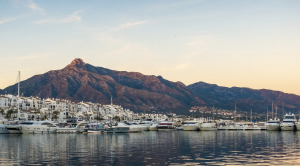
A compromise followed. Alfonso brought in his own architect, Noldi Schreck, to soften Banús’s original vision of high-rise towers into something closer to a traditional Andalusian village: whitewashed walls, terracotta roofs, narrow streets opening onto small squares, all wrapped around a harbour built for serious yachts.
Puerto Banús opened in May 1970. The launch party alone drew Prince Rainier and Princess Grace of Monaco, the Aga Khan, and members of the Spanish royal family. It worked exactly as intended: the world took notice, and it never really stopped watching.

Boom, Excess, and a Reckoning
The 1980s and early 1990s brought rapid growth, and not all of it careful. Marbella’s mayor at the time, Jesús Gil, oversaw a construction boom that reshaped much of the town, often with little regard for planning rules. Some of what got built during this period is exactly what critics still point to when they talk about the coast’s rougher edges: overdevelopment, legal disputes, a reputation for excess that outlasted the era itself.
It took years, and a change in local government, to repair Marbella’s standing. The clean-up that followed in the 2000s focused on planning discipline, quality over volume, and a deliberate return to the understated tone the Marbella Club had set decades earlier.
What Stuck
Two things from that original story never really left.
The first is privacy. From Alfonso’s earliest days at the finca, Marbella positioned itself as a place where prominent people could be somewhere beautiful without being on display. That instinct still shapes how the best properties here are designed and marketed: gated, discreet, rarely photographed from the street.
The second is architectural restraint. Even at its most commercial, the coast has generally resisted turning into a wall of glass towers. Puerto Banús could easily have looked like Miami. Instead, thanks to one uncomfortable negotiation in the 1960s, it looks like an Andalusian village that happens to have superyachts parked in front of it.

Why This History Still Matters to Buyers
None of this is trivia. It explains why the Golden Mile still commands the prices it does, why Nueva Andalucía and Puerto Banús developed such a different character from central Marbella, and why certain areas of the coast still carry more weight with serious buyers than newer developments with better amenities on paper.
Marbella didn’t become an international address by accident, and it wasn’t inevitable either. It was built, deliberately, by a handful of people who wanted something specific: a place that felt private, unhurried, and quietly expensive. Seventy years on, that’s still the product being sold.