3SA Dubai secured one of the most significant ultra-prime residential deals in the city’s history: the sale of a 31,108 sq ft, six-bedroom, three-storey penthouse at Aman Residences Dubai for €110 million — approximately $115 million. Registered with the Dubai Land Department on 3 March, it is the third most expensive apartment ever sold in the emirate by total price, and the most expensive of all by square footage.
The property does not yet exist. It is, as Widén puts it, “just a pile of sand.” What makes the transaction remarkable is not only the number on the contract, but the moment it was signed: four days before registration, Iran had launched an unprecedented wave of over 1,100 missiles and drones at Gulf nations, raining debris on Dubai’s Palm Jumeirah, setting fire to the Burj Al Arab hotel, and sending residents — nearly 90 per cent of the city’s 11 million people are foreign nationals — sheltering into basement car parks as flights were cancelled and the UAE closed its airspace.

A Record Written in the Sand
The numbers attached to this transaction are striking even by Dubai’s inflated standards. At €110 million, the penthouse ranks as the third most expensive apartment ever sold in the emirate by total price. But it is the price per square foot that makes it genuinely historic: at roughly $3,700 per square foot, it surpasses any comparable off-plan sale in the city’s record books.
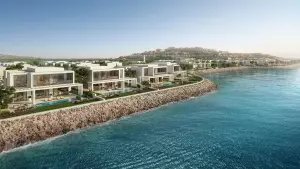
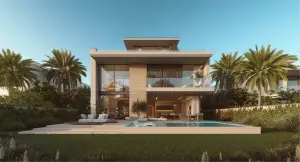
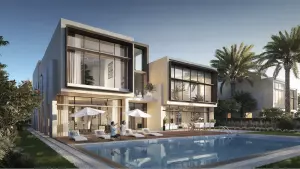
The property sits within Aman Residences Dubai, a development on the Jumeirah Peninsula comprising three towers of approximately 30 storeys each. One building will operate as a luxury hotel; the other two will house 78 private residences. The penthouse itself occupies the top three floors, commands views across Dubai’s glittering skyline and the white sands of Jumeirah beach, boasts eight parking spaces — more than the six bedrooms — and features a bespoke terrace pool. Designed by the celebrated Kerry Hill Architects, the project draws on the region’s architectural heritage with sand-coloured stone, shaded galleries, intricate privacy screens, and bronze accents. Construction was scheduled to begin in April 2026, with completion targeted for 2030.
The deal itself was struck earlier: agreed on 23 December 2025 between the buyer and the developer, H&H Development, it was registered with the Dubai Land Department on 3 March 2026 — four days after Iran’s retaliatory strikes began. Payment is structured in four tranches: 30 per cent on signing, 10 per cent after one year, another 10 per cent after two years, and 50 per cent on completion in 2030.
For 3SA Dubai, the sale represents a personal and professional landmark of a different order entirely. “The largest off-plan property I had sold before this was €8.2 million, so you can imagine the difference,” Jimmy says.

Missiles, Force Majeure, and the Logic of the Ultra-Wealthy
The timing raises an obvious question: why would anyone finalise a nine-figure property purchase in a city that was, at that precise moment, under aerial bombardment? The answer lies in understanding how decisions are actually made at this level of wealth.
It’s not a spontaneous buy with something like this, “It’s a strategic decision to put the money in a very safe investment. On this level it’s very rare that people wobble.” The buyer was aware of the force majeure clause in the contract — a provision that would have allowed either party to walk away without penalty given the extraordinary geopolitical circumstances. They chose to proceed anyway.

How 3SA Estate Closed the Deal
For 3SA Estate, the transaction is the product of years of deliberate positioning in Dubai’s ultra-prime segment. The brokerage, which operates across Dubai and Marbella, has built its reputation on a buyer-first model — prioritising the client’s long-term interests over transactional speed. That approach proved its value at the highest possible level here.
On pricing, Widén is characteristically direct. The developer would not have negotiated below the asking price under any circumstances. And looking forward, he believes the property’s value has already appreciated significantly since exchange. “I think the property is already now worth 30 or 40 per cent more. Simply because the most unique locations and properties always have a buyer.”

The Branded Residence Boom and Its Limits
The Aman sale belongs to a specific and spectacular corner of the market: branded residences, in which luxury hospitality names lend their identity and service model to private apartments. In Dubai, this sector has been one of the most powerful drivers of ultra-prime prices. According to Morgan’s International Realty, the city closed 2025 with 166 branded residence projects and 51,692 units, after 34 new projects launched that year alone.
Branded residences in Dubai command an average premium of roughly 40 per cent over non-branded equivalents. At the ultra-prime end, the gap is even wider: in Jumeirah Bay Island, branded residences have fetched premiums of up to 98 per cent compared to traditional homes in the same area. The average achieved price across Dubai’s branded sector closed 2025 at $1,028 per square foot — a 15 per cent increase on the prior year. Aman Residences ranked third in per-square-foot pricing across the entire branded segment, behind only Atlantis The Royal and Jumeirah Asora Bay.
The broader trophy market has been similarly vertiginous. In December 2025, a penthouse at Bugatti Residences by Binghatti in Business Bay sold for $149.76 million — the most expensive single residential transaction in Dubai’s history. The city recorded more than 500 residential sales above $10 million in 2025, up from just 30 in 2020. Total branded residence transaction values rose 38 per cent year-on-year.
Whether the conflict represents a temporary pause in this trajectory or something more structural remains genuinely uncertain. Dubai has recovered from shocks before — the 2008 financial crisis, the 2014 oil price crash, Covid — and each time it has attracted a new wave of wealthy incomers. Henley & Partners, which advises the global rich on second residencies and citizenship, noted that an estimated 9,800 millionaires moved to Dubai in 2025, bringing $63 billion in wealth, more than any other city on earth.

For ultra-high-net-worth buyers considering Dubai, the Aman Residences transaction offers several important signals. The most exceptional properties in the most exceptional locations continue to attract serious capital and hold their value through market cycles. Off-plan purchases at the ultra-prime tier — where developers of Aman’s standing do not discount — reward buyers who move with conviction at the right moment. And the branded residence sector’s structural premium over non-branded property shows no signs of narrowing: with records still being broken in 2026, Dubai continues to assert itself as the dominant global hub for ultra-luxury real estate.
3SA Estate advises clients across both Dubai and Marbella on exactly these kinds of decisions — identifying the properties that will hold and grow their value over time, structuring acquisitions in the client’s best interests, and providing the market intelligence that only comes from operating at the highest level of the sector. If you are considering an ultra-prime acquisition in Dubai or Marbella, we would be glad to discuss your requirements in confidence.